RESEARCH NOTE /
Adaptively Acquiring Shadows of a Quantum System from Very Few Measurements via RL
“Don’t measure randomly. Let AI learn what to measure.”
1. The Problem: The Measurement Bottleneck
Efficiently characterizing quantum many-body systems is a prerequisite for verifying quantum devices. Traditional tomography scales exponentially with system size (d = 2^n). While randomized protocols like Classical Shadows circumvent this scaling, they rely on fixed, task-agnostic sampling distributions and often waste the measurement budget on uninformative subspaces.
2. Key Innovation: “Learning to Measure”
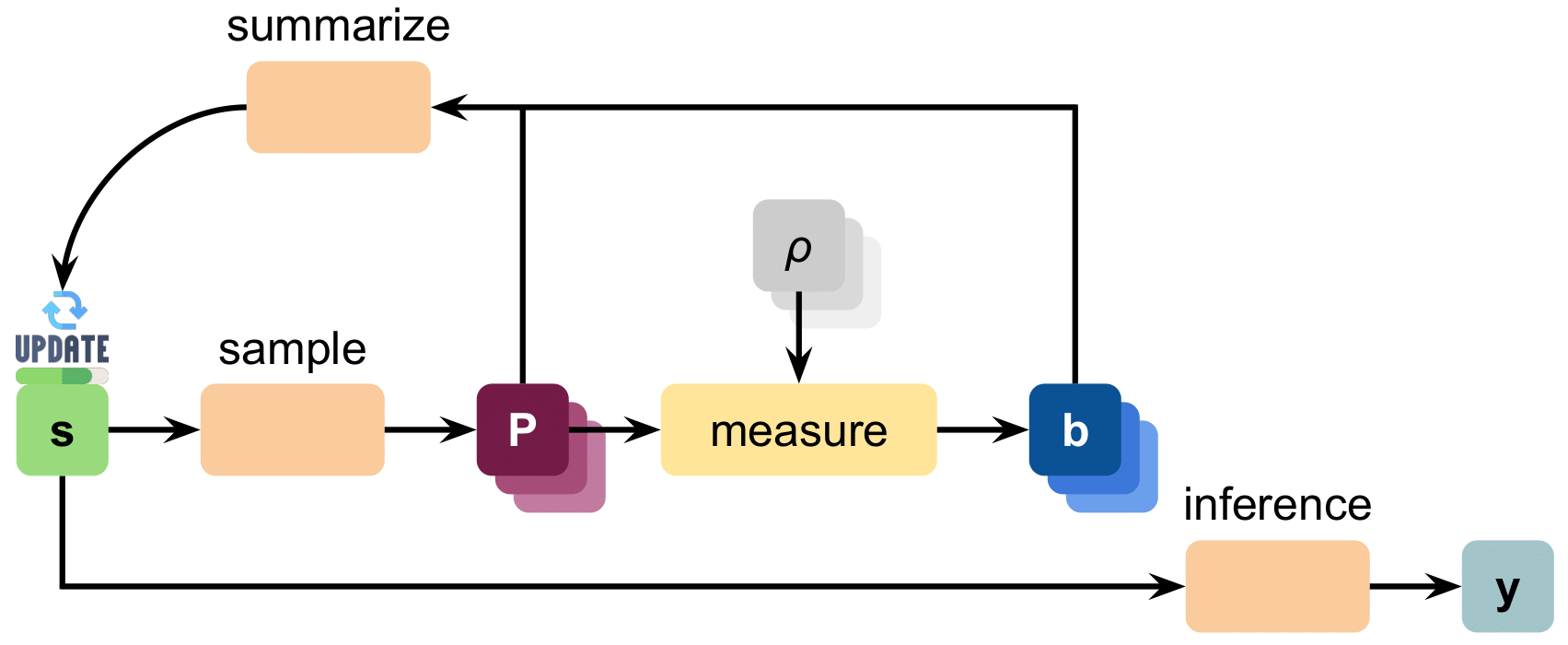
I propose a general-purpose Reinforcement Learning framework that treats the measurement process as a sequential decision-making problem. Unlike static protocols, our agent dynamically selects the optimal Pauli basis (X, Y, Z) conditioned on the history of previous measurement outcomes.
- Architecture: A Transformer-based policy network captures correlations across qubits and measurement history to predict the most discriminative basis in real-time.
- Method: The agent operates in a feedback loop, updating its internal belief state with every new bit outcome to maximize classification accuracy with minimal sample complexity.
3. Why It Matters
This framework shifts the paradigm from random sampling to adaptive, task-oriented acquisition.
- Sample Efficiency: Achieves high accuracy in classifying entangled states (GHZ, W) and diagnosing noise with significantly fewer samples compared to random baselines.
- Versatility: The architecture generalizes to diverse tasks, including noise diagnosis, purity certification, and entanglement characterization.